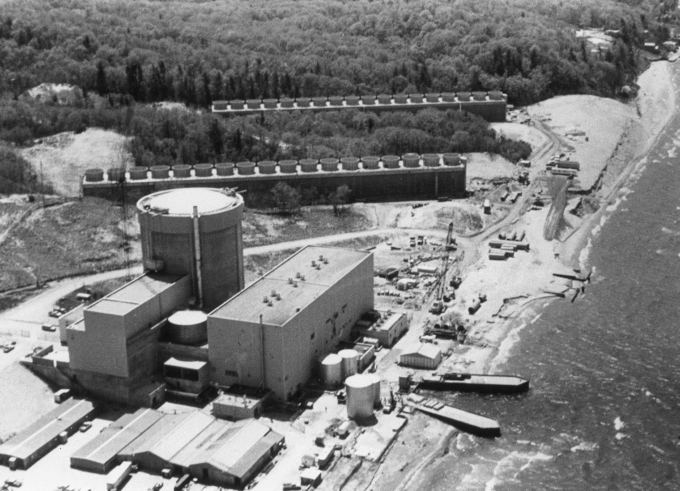
Palisades Power Plant in 1974, image Wikipedia.
As President Trump and Secretary of War Pete Hegseth try to deflate Iran’s nuclear energy industry, our nation faces a national security threat at a controversial swing-state reactor.
A failed Department of Energy (DOE) attempt to restart the ailing Palisades nuclear power plant near South Haven, Michigan, may become the midterms’ October surprise.
Unlike the Ayatollah’s nuclear energy project, an opaque Camden, New Jersey company has run into big trouble trying to restart this antique reactor with the full faith and credit of the Trump administration.
Holtec International’s Palisades reactor has become a poster child for the “What, Me Worry?” folks at what’s left of Trump’s downsized and “doged” Nuclear Regulatory Commission. This clear and present danger should be a target for Congress to dismantle.
The latest disaster here on the Lake Michigan shoreline was triggered August 30 by an unprecedented operational error with potentially grave consequences. Like many previous mistakes this one suggests that Holtec is incapable of safely running a reactor.
This unfortunate event inside the Palisades reactor core appears to have demolished Holtec’s multi-billion-dollar federal and state-subsidized plan to reopen the long-delayed plant this year.
For much of the past month, the Nuclear Regulatory Commission tried to hide the frightening news that a Holtec team “tilted from its upright position” a dangerously radioactive 1,000-pound nuclear fuel assembly.
In plain English, Holtec’s euphemistic press release means a critical part of the reactor is stuck. As a result, loading of several hundred new and spent fuel assemblies, which normally takes about a week, is stopped cold.
At the moment, this controversial company says it is “developing equipment for the fuel retrieval and on-site storage equipment to return the fuel through a channel from the reactor to the spent fuel pool.”
This emergency work is well outside the normal operational realm of nuclear reactors. It’s hard to see how the new problem can be resolved short of abandoning the restart plan.
Part of the problem is censorship. Trump’s publicity-shy NRC routinely delays disclosure of safety-related issues like this one for weeks, even months. In effect this so-called watchdog agency answers only to itself.
The biggest question Holtec and the NRC refuse to answer is the angle of the unexpected “tilt”. To date there are no photographs of this misplaced fuel assembly. The public has no way to know how badly this dangerously radioactive unit is listing. One possibility is that it tipped over and is now lying underwater on the reactor floor.
All this is happening four years after the money-losing plant was closed. Previous owner Entergy, a well-regarded nuclear fleet operator, couldn’t afford long-overdue safety upgrades, including new steam generators.
The plant was sold in 2022 to Holtec which promised “a safe and timely decommissioning” that was “welcome news for the plant’s community.”
A week after the deal closed the company suddenly announced a plan to resurrect Palisades, financed in part with money apparently committed for decommissioning.
One of the big challenges for this publicly funded reactor reboot has been a series of surprises contributing to the two-year restart delay.
The latest “tilted” fuel assembly disaster comes as no surprise to industry experts watching the first-ever attempt to restart a reactor that is set to be permanently closed.
It also makes the plant a target for critics of Trump’s full-steam-ahead approach to nuclear at the expense of much cheaper and quicker-to-build renewables like wind, solar, and hydro. Today, $16 per watt nuclear power can’t compete with carbon-free wind and solar that cost $1 per watt.
Another big problem is poised to capture the attention of the media and the public at large in the wake of the August fuel-reloading catastrophe.
Any attempt to restart this reactor today immediately raises big questions about the possibility of an event that could release radiation downwind of Palisades. Conservative pro-nuclear experts with decades of industry experience worry about a potential loss-of-control-driven accident.
That possibility is related to other major problems at this reactor. A restart would mean operating outside the normal, in-depth safety regulations governing the rest of our nation’s reactor fleet.
Palisades is being rebuilt outside public scrutiny. Particularly troubling is the fact that under Trump’s NRC, Holtec is effectively self-regulating in a manner similar to the AI industry. Absent an independent inspection the public has no way to know what has just gone terribly wrong inside the reactor.
After team Trump made history last year with the first-ever presidential firing of an NRC chairman, the White House gutted the agency with a series of cutbacks defying common sense. For example, during last year’s lengthy Congressional budget crisis, calls to the agency’s shuttered media office went to voicemail with no reply.
This kind of regulatory impotence echoes the story of another Michigan reactor, Fermi 1, the subject of John G. Fuller’s legendary We Almost Lost Detroit. This 1966 near meltdown that shut down the dangerous plant for good was effectively hidden from the public by the NRC’s predecessor, the Atomic Energy Commission, for eight years.
This lack of transparency is central to the NRC’s playbook. Understandably, the unfolding Palisades debacle could easily impact the ballots of some voters who live in states like Michigan, Wisconsin, Illinois, Ohio, and Indiana. Cities like Chicago, Milwaukee, Detroit, and Grand Rapids are all potentially in harm’s way.
If the plant safeguards fail, a number of communities could be in the path of a radiation release, depending on which way the wind blows. That news would be impossible for the NRC to hide.
While the likelihood of this event is beyond the crystal ball of any midterm pollster, one thing is certain: No one can predict how Trump’s NRC and DOE can escape responsibility. This controversy could quickly trigger protests similar to the ones putting political brakes on the national data center rollout.
It’s easy to understand why Trump is determined to restart Palisades along with shuttered reactors in Pennsylvania and Iowa. He sees this as a quick way to bypass the fifteen to 20 year timeline it takes to build a conventional light water reactor.
At the moment Holtec, a nuclear reactor newbie that has never sold a kilowatt of atomic energy, does not have a quick fix for the current Palisades impasse. Every day the reopening is delayed exposes the company to public ridicule.
At this point the right thing to do would be to immediately bring in an experienced operator like previous owner Entegy to remedy the dropped fuel assembly crisis. Instead, this inexperienced company is headed back to the drawing board to invent corrective action. Submitting to NRC inspection and review, public comment and hearings could take many worrisome months.
In the wake of this failure, the company has already been forced to “postpone” an investor roadshow aimed at promoting a much-needed $900 million initial public offering. This happened September 17, just nine days after the IPO was announced.
This latest challenge comes not long after Holtec International’s President, chief nuclear and safety officers all left the company.
In September, shortly after telling the New York Times that the long delayed attempt to restart this dangerously obsolete plant is “like building a fire truck on the way to a fire”, plant manager Jeff Borah also departed.
A big part of the problem, he explained, was the fact that Holtec “didn’t take the time to really plan out the whole project before we started doing the work.”
Top executives who worked at Palisades for Entergy believe the latest accident could potentially kill the restart, a classic example of corporate socialism. To date, the federal and state tab for loans, subsidies, and grants is well over $2 billion.
Under the leadership of Trump’s Energy Secretary Chris Wright, the DOE has already appropriated $400 million toward Holtec’s multi-billion-dollar plan to build more reactors at the Palisades site.
Don’t Waste Michigan’s Kevin Kamps, a Holtec watchdog who has tracked this plant for decades, says Palisades and four other proposed Holtec Michigan reactors would require up to $16 billion in federal and state grants, loans, and subsidies.
At the moment, nuclear energy scientists who have worked at and studied this plant for many years are especially concerned about the reactor’s antiquated steam generator tubing.
Recent unauthorized and unorthodox Palisades steam generator tube welds do not meet the American Society of Metallurgical Engineers’ requirements. Instead of insisting the welding work be redone correctly, the NRC issues yet another waiver for Holtec.
Equally worrisome is the fact that 1,400 tube cracks have been plugged or sleeved thanks to NRC waivers. This does not mitigate the possibility that many more cracks will appear when the plant restarts.
These cracks could lead to rupture in one of the thousands of potentially vulnerable tubes. That would release significant radiation to the atmosphere that could force evacuation of residents near the plant.
In any case, if and when the reactor does eventually restart, it will have to shut down months ahead of its normal 18-month operating cycle. Experts I have spoken to doubt that Holtec will be able to keep the plant going for a planned 14-month cycle. They predict it will be lucky to stay open for a year.
While the NRC dithers, Holtec faces a big financial challenge on this restart.
Further delay means the company may not be able to generate its sole source of Palisades income, selling electricity, including some power that might go to data centers. As a result Holtec could potentially default on a $1.52 billion federal loan that the company must begin repaying next spring.
Keep in mind that Entergy, and to some extent its predecessor, Consumers Power (now Consumers Energy), abandoned the plant because neither was willing to invest many hundreds of millions for safety upgrades deferred for decades.
Leading the list is the astonishing fact that unlike every other nuclear plant in America, Palisades has not met NRC fire protection regulations implemented in 1975. They were put in place after the disastrous Brown’s Ferry reactor blaze.
This is not reassuring to people in South Haven after a scary September 26 plastic plant fire knocked out power to the entire town and forced a homecoming cancellation.
Despite the bad news at Palisades, Trump is moving quickly on his nuclear renaissance dream. He doesn’t understand that the Michigan plant could cause reputational damage to the entire nuclear power industry.
On top of all this, the President remains vulnerable for another reason. Trump has an obvious conflict of interest because his family media company co-owns a multi-billion dollar nuclear startup.
At the moment it’s impossible to speculate on damage done to the reactor, how the latest problem will be fixed, if Palisades can reopen, and how long it can survive in the face of a host other safety related issues that could kill the startup.
Meanwhile, the public safety issue for Midwestern communities potentially downwind of a Palisades nuclear nightmare remains front and center.
As team Trump fails to bury the story told here, it’s obvious that the NRC’s lax oversight led directly to the fuel loading fiasco. This opens a much larger question about the downsized NRC team’s ability to regulate 57 nuclear power plants operating 96 American reactors. To save face, public pressure could force the NRC to reverse course and slow down the previously approved Palisades restart.
Holtec’s failure to understand the good reasons why both Consumers Power and Entergy walked away from Palisades led to the company’s latest crisis. The sad history of this plant explains some of the many reasons why a restart looks like a fool’s errand.
One big problem is Holtec’s naive attempt to restart with obsolete steam generators that should have been replaced decades ago. Buying replacements could take five years or more and cost upwards of half a billion dollars.
A potential Palisades media and political uproar could be a threat to Trump loyalists like Congressman Bill Huizenga. He sees the plant as an economic boon to his West Michigan district.
Nuclear power experts I have spoken to say there is a one in 20 chance that reopening this plant could lead to a dangerous radiation release following a tube rupture. That’s not the kind of odds, for example, one would be willing to take when boarding a 50-year-old airplane, especially one that doesn’t meet current FAA safety standards.
It is not a stretch to calculate the damage a Palisades restart could do to the West Michigan business, agriculture, real estate and tourism industries. Beyond potential radiation issues is the fact that adverse publicity could have vast economic consequences.
Adding to the political controversy is the fact that property owners’ insurance policies exclude damage from nuclear power accidents.
Trump and Energy Secretary Chris Wright can no longer showcase Palisades as the model gateway to a booming nuclear power industry. This failure to launch the Michigan reactor could undercut faith in other nuclear startups, including the one Trump’s family co-owns.
Trump and Hegseth, the same leaders who brought you the war in Iran, are now expediting other nuclear power plant startups. President Trump has mandated DOE’s Wright to build 10 new nuclear reactors at a record pace, kickstarted by a $17 billion federal loan.
To speed up the process, Trump has issued an executive order that cuts some traditional nuclear power plant safety regulations. Hegseth, who has no background in atomic energy, is preparing to greenlight nuclear facilities on military property exempt from NRC regulation.
Equally troubling is Holtec’s track record with state and federal regulators. In 2010, this unique company was issued a 60-day disbarment from federal work after it was caught paying $54,000 to a Tennessee Valley Authority employee to maintain or continue its contract. Failure to disclose this on a subsequent $260 million New Jersey tax-break application caught up with Holtec. In 2024 the company was forced to pay a $5 million state fine to avoid prosecution.
Since retaking office in 2025,Trump has done everything possible to promote nuclear power short of going for a dip in the Palisades reactor pool, something that happened to an unfortunate Holtec employee last fall. Thanks to the fact that she was life jacketed, this victim was fished out and decontaminated.
Every day that Trump’s NRC fails to hold Holtec accountable makes the plant riskier. Come November, that shortsighted decision could have a major impact at the polls, especially in critical Midwestern battleground states like Michigan and Wisconsin.